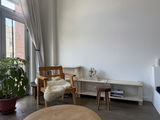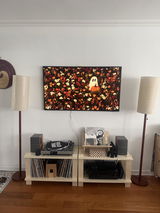
The average flat pack furniture purchase comes with a bag of hardware, an Allen key, and about 47 minutes of your life. The UNFNSHED Side Table assembles in under 3 minutes, with nothing in your hand except the two panels. That difference is not a convenience feature. It is an engineering decision that changes how long the furniture lasts.
Flat pack furniture is not one thing. It spans pressed-wood shelves you would not trust with a hardback book to 13-ply premium-grade plywood pieces that outlast the apartments they live in. This guide explains what separates them, and why the hardware-free version is not a gimmick.
What flat pack actually means
Flat pack furniture ships in panels sized to fit inside a box. Once it arrives, you assemble the pieces at home. The category took off with IKEA in the 1950s because it cut shipping costs dramatically and made furniture accessible at scale. A flat box is more efficient than a pre-assembled chair by every logistical measure.
The catch has always been the assembly. Standard flat pack relies on hardware: cam locks, dowels, Allen bolts, wooden pegs. These connectors are made from materials softer than the furniture itself. Over time, especially in particleboard constructions, the cam lock holes strip out, the dowels loosen, and the piece wobbles. That is not a defect. It is the expected endpoint of the design.

Why hardware is the weakest link
Hardware is not just an inconvenience. It is a structural liability. Cam locks tighten by thread. Threads wear. A particleboard cam lock hole can strip after 3 to 5 disassembly cycles. Move twice and the joint starts rocking. It was engineered to be assembled once.
Plywood furniture with metal hardware fares better because plywood holds fasteners more reliably than particleboard. But the hardware is still the limiting factor. Metal corrodes, loosens, and can crack the surrounding wood fiber if overtightened. Every hardware connection is a future failure mode that does not exist in a hardware-free design.
"The hardware bag is evidence that the joint tolerances are not tight enough to hold the piece together on their own."
The alternative is to make the wood do the work. Tight friction-fit joints, CNC-cut to tolerances under 1mm, hold solid because the grain structure of the wood resists the pressure by compression. No corrosion. No thread wear. No stripped holes.
How friction-fit joints work
A friction-fit joint is two panels shaped so that they slot together and resist movement by compression. Think of a wooden puzzle piece: no glue, no screw. The shape keeps it together.
To make a friction-fit joint that holds furniture weight, the wood must meet two conditions. First, it must be dimensionally stable. Particleboard swells with humidity and the joint loosens. Softwood compresses over time and the joint loosens. 13-ply premium-grade plywood holds its dimension across humidity swings because alternating grain direction in each ply counteracts warping in both axes.
Second, the CNC cut must be accurate to under 1mm. A 3/4-inch panel slotting into a slot that is 0.5mm too wide will feel loose within weeks. A slot cut to tolerance stays snug for years.

The assembly reality check
Standard flat pack
45 to 90 minutes. Hardware bag with 8 or more part types. Instructions requiring correct orientation of every piece in a specific sequence. Cam locks accessible only in a fixed order. One stripped hole means a trip to the hardware store or a permanently wobbly piece.
UNFNSHED friction-fit
Under 5 minutes for most pieces, under 3 minutes for the Side Table. No bag, no hardware, no tool. The Side Table is two panels and a leg. The Mini Side Table is a single panel slot. The No-Tool Stool snaps together in the correct position by design: if you could assemble it wrong, we redesigned it until you could not.

What to look for before you buy
Hardware vs. hardware-free: the honest comparison
Why it works
- No stripped holes, ever
- Disassemble and reassemble indefinitely
- Assembly under 5 minutes for most pieces
- Zero hardware to lose during a move
- Joint strength comes from wood structure, not metal thread
What to know
- Requires precise CNC manufacturing (not all brands achieve this)
- premium-grade plywood costs more than particleboard or MDF
- Joint geometry is fixed: you cannot add shelves or modify post-purchase
- Not every aesthetic suits exposed plywood edges
 Fully assembled in the time it takes to find an Allen key in a junk drawer.
If you are shopping for your first piece, the UNFNSHED Side Table is the clearest demonstration of how friction-fit assembly works at the furniture level. Two panels, one leg, zero hardware. If you want to see the full range, the full catalog shows every product built the same way.
Flat pack furniture questions
What is flat pack furniture?
Flat pack furniture ships in panels or components sized to fit in a flat box, which you assemble at home. It reduces shipping costs and makes furniture affordable to distribute nationally. Most flat pack uses hardware such as cam locks, Allen bolts, and dowels. Some brands use friction-fit joints that require no hardware at all.
Is flat pack furniture good quality?
It depends on the material and the joint design. Particleboard flat pack degrades quickly at joints. 13-ply premium-grade plywood flat pack with friction-fit joints is furniture-grade and durable. Hardware-based joints wear out after repeated disassembly. Friction-fit joints do not.
How long does flat pack furniture take to assemble?
Standard IKEA-style flat pack takes 45 to 90 minutes for most pieces. Hardware-free flat pack with friction-fit joints takes under 5 minutes. The UNFNSHED Side Table is under 3 minutes because it is two panels and a leg with no hardware to locate or tighten.
Can flat pack furniture be disassembled and moved?
Yes. Hardware-based furniture degrades after 3 to 5 disassembly cycles as cam lock holes strip out. Friction-fit plywood furniture can be disassembled and reassembled indefinitely because the joint integrity comes from the wood structure, not from hardware threads or cam mechanisms.
What is the difference between flat pack and self-assembly furniture?
The terms are often used interchangeably. Flat pack describes how the furniture ships. Self-assembly describes how you build it. The more useful distinction is hardware-based versus hardware-free assembly, which determines long-term durability and assembly time.