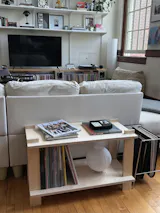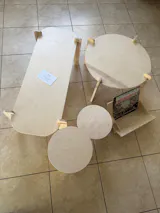
Baltic birch plywood furniture has 13 plies. Standard furniture plywood has 7 to 9. That number is not a marketing claim: a 30-inch Baltic birch shelf at 3/4-inch thickness deflects approximately 0.028 inches under 25 lbs, while a comparable pine shelf at the same span deflects 0.071 inches under the same load. Over a year, the pine shelf bows visibly. The Baltic birch shelf does not.
We build every UNFNSHED piece from 13-ply Baltic birch because we tested the alternatives and none held tolerances tight enough for friction-fit joints. This guide explains what that means for anyone buying or specifying furniture.
What is Baltic birch plywood
Baltic birch is a specific grade of plywood manufactured primarily in Russia, Finland, and the Baltic states. It is not the same as standard birch plywood sold at lumber yards, which often uses birch only on the face veneer and lower-grade wood for the inner plies.
True Baltic birch uses birch veneer for every ply, including the core. Each ply is approximately 1.5mm thick. A 3/4-inch (18mm) sheet contains exactly 13 plies. Grade B/BB (the furniture standard) requires a void-free core, meaning no knots, gaps, or internal voids that would weaken the panel or compromise a machined joint.
 13 plies, each approximately 1.5mm. The alternating grain direction in every layer prevents warping in both axes.
Why ply count matters for furniture
Every additional ply in a panel adds one more layer of cross-grain material. Cross-grain layers resist bending in the perpendicular direction. At 13 plies, the panel behaves almost isotropically: it resists bending equally in both directions. This is why Baltic birch panels stay flat under load where single-species boards cup and bow.
The practical consequence is measurable. Using Sagulator deflection calculations with a modulus of elasticity of 1.5 million psi (Baltic birch) versus 1.2 million psi (construction-grade pine), a 30-inch shelf at 3/4-inch thickness shows 60% less deflection under an identical evenly distributed load. That gap does not close over time. The pine shelf keeps deflecting incrementally. The Baltic birch shelf holds its position.
"The void-free core is not a quality designation. It is a manufacturing requirement for any joint that needs to hold tolerance under load."
 Left: particle board with visible voids and filler. Right: 13-ply Baltic birch with solid, void-free birch throughout every layer.
The friction-fit connection
The reason UNFNSHED uses Baltic birch specifically rather than standard plywood or MDF comes down to joint tolerance. Our friction-fit joints are CNC-routed to a gap of under 1mm. At that tolerance, any internal void in the plywood becomes a failure point. When the CNC bit passes over a void, it deflects slightly, leaving a slot that is fractionally wider. A fractionally wider slot means a looser joint. A looser joint means the furniture wobbles within months.
Baltic birch grade B/BB has no internal voids. Every slot we cut hits solid birch fiber. The result is a joint that holds tight without hardware and without glue, for the life of the piece.
Baltic birch vs. the alternatives
Why Baltic birch wins
- 13 plies vs. 7 to 9 in standard furniture plywood
- Void-free core: no joint failure from internal gaps
- ~60% less deflection than pine at the same span (Sagulator)
- Dimensionally stable across humidity changes
- Edge shows 13 ply stripes: an aesthetic statement, not a flaw
What to know going in
- Costs 2x to 3x more than particleboard furniture
- Heavier than MDF per square foot
- Natural grain variation means each piece looks slightly different
- Unfinished surface benefits from a protective oil in high-humidity spaces
What Baltic birch furniture looks like over time
Unfinished Baltic birch starts as a pale blond with tight grain. Over months in a lit room, UV exposure develops a warm amber patina. The patina is even and gradual, not blotchy, because every ply is birch: the color development is consistent through the panel, not just on a surface veneer.
If you apply a finish, Baltic birch takes stain and penetrating oil evenly because the face veneer is consistent grain. A wiping oil like Rubio Monocoat or Osmo Polyx brings out the ply stripe at the edge without obscuring the face grain. Painted finishes bond well to the birch surface without a sealer primer in most cases.
 The exposed edge on the wall shelf shows 13 visible ply stripes. That is the detail most furniture manufacturers hide with edge banding.
Our Baltic birch wall shelves ship unfinished so the patina is yours to develop, not predetermined by a factory coat. The wall shelf listing includes finish guidance based on the exact plywood we use.
 Every panel ships flat and unfinished. The 13-ply edge is visible on every piece we make.
Baltic birch plywood furniture questions
What is Baltic birch plywood furniture?
Baltic birch plywood furniture is furniture built from a specific grade of plywood that uses birch veneer for all 13 plies at 3/4-inch thickness, with a void-free core. It is stronger and more dimensionally stable than standard plywood, particleboard, or MDF furniture. The exposed ply edge showing 13 thin stripes has become a design signature in Scandinavian and minimalist furniture.
Is Baltic birch plywood good for furniture?
Yes. Its 13-ply structure gives it approximately 60% less deflection than pine at the same span, based on Sagulator calculations comparing a modulus of elasticity of 1.5 million psi (Baltic birch) versus 1.2 million psi (pine). The void-free core means CNC-cut joints hold more reliably than in standard plywood or particleboard.
How many plies does Baltic birch plywood have?
A 3/4-inch (18mm) sheet of Baltic birch plywood has 13 plies, each approximately 1.5mm thick. Standard furniture plywood typically has 7 to 9 plies at the same thickness, with inner plies made from lower-grade softwood. Baltic birch uses birch for every ply including the core.
How much weight can a Baltic birch shelf hold?
At 3/4-inch thickness spanning 30 inches between supports, a Baltic birch shelf holds approximately 50 lbs with under 0.03 inches of deflection based on Sagulator calculations. At a 22-inch span, load capacity increases substantially. Specific ratings depend on span length, bracket spacing, and whether the shelf is wall-mounted or freestanding.
Does Baltic birch furniture need to be finished?
No. Unfinished Baltic birch is stable in normal indoor environments and develops a warm amber patina over time from UV exposure. In high-humidity spaces, a penetrating oil like Rubio Monocoat or Osmo Polyx protects the surface without obscuring the grain. Painted finishes also adhere well without a sealer primer in most cases.