The nightstand problem in a small bedroom is not about style. It is about inches. Most nightstands are 24 to 28 inches tall and 18 to 22 inches wide. In a room where the bed is 6 inches from the wall on each side, a standard nightstand takes up clearance you cannot afford to lose.
This is the guide to finding a small space nightstand that solves the measurement problem first and looks intentional second.
The numbers that actually matter
Before you look at any nightstand, measure two things: the clearance between the side of your bed frame and the nearest wall, and the height of your mattress top from the floor.
 The Mini Side Table in a bedroom with less than 12 inches of clearance on the side. This is the minimum viable setup for a tight apartment bedroom.
Three small space nightstand configurations that work
Option 1: The Mini Side Table (clearance under 14 inches)
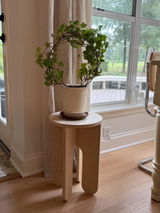
The UNFNSHED Mini Side Table is 12 inches in diameter. It fits in spaces where a standard nightstand is physically impossible. The round footprint means no sharp corners in a narrow walking path, and the open-base design does not visually crowd a tight room. At 18 inches tall, it works best with platform beds and lower mattress profiles.
Option 2: The Modern Nightstand (clearance 14 to 20 inches)
The UNFNSHED Modern Nightstand is 15 inches wide, 22 inches tall, and 14 inches deep. It fits in bedrooms where a standard-width nightstand would block the walkway but you still want a dedicated bedside surface with a lower shelf for books or a basket. The lower shelf is the practical advantage over a plain side table.
Option 3: Wall-Mounted Shelf (no floor clearance available)
If floor clearance is under 10 inches on both sides, wall-mounted wood shelves are the answer. A 22-inch wide shelf at the right height gives you a bedside surface and storage without occupying any floor space. The tradeoff is that you need to patch the wall if you move.
"Measure your mattress height before you look at anything. It determines your nightstand height, which determines which products work. Most people do this in the wrong order."
What not to put on a small space nightstand
The constraint of a compact nightstand forces good habits. A small surface means you cannot pile things on it. This is an advantage, not a limitation.
The UNFNSHED Modern Nightstand has a lower shelf that takes pressure off the top surface. Books, a small plant, a basket for chargers and remotes, all of that moves to the lower shelf and the top stays clean.
 Three objects maximum on the top surface. Phone, water, and one more. The lower shelf handles everything else.
The unfinished wood advantage in small rooms
In a small bedroom, every visual element competes for attention. Dark, lacquered furniture in a tight room makes the space feel smaller. Light-colored, unfinished wood does the opposite: the natural premium-grade plywood tone reflects light and keeps the room feeling open even when the actual square footage is limited.
The other advantage of unfinished premium-grade plywood is that it does not date. A painted MDF nightstand from five years ago shows its age. premium-grade plywood looks the same in year one as it does in year ten, and if you decide to paint or stain it, you can. Most painted furniture cannot be convincingly undone.
The UNFNSHED Modern Nightstand ships in natural premium-grade plywood. You can leave it as is, apply a clear coat to protect the surface, or stain it to match existing wood tones in the room. Assembly takes under five minutes with no tools.
 The Modern Nightstand in natural premium-grade plywood. No finish, no paint. Just the plywood and clean lines.
Small space nightstand questions answered
What is a good nightstand size for a small bedroom?
For small bedrooms, a nightstand between 12 and 16 inches wide and no deeper than 14 inches is ideal. The height should land within 2 inches of your mattress top. If floor clearance is under 14 inches on the side of the bed, consider a 12-inch round side table or a wall-mounted shelf instead of a traditional nightstand.
Can I use a side table as a nightstand in a small bedroom?
Yes, and in many small bedrooms a side table is a better choice than a nightstand because it has a smaller footprint. A 12-inch round side table fits in spaces where a traditional nightstand is physically impossible. The tradeoff is that a side table has no lower shelf, so storage is limited to the top surface.
How much space should be between the bed and the nightstand?
Ideally no gap at all between the mattress edge and the nightstand surface. The nightstand should be close enough to reach without sitting up fully. If there is more than 8 to 10 inches of gap between the bed edge and the nightstand, it is functionally too far away for most people to use comfortably at night.
What is the best material for a small space nightstand?
Solid plywood like premium-grade plywood is the best material for a small space nightstand because it is light-colored enough to keep the room feeling open, durable enough to hold up to daily use, and stable enough not to wobble on carpet. Avoid hollow core furniture in a small bedroom as it tips easily when the surface is used as a handhold getting in and out of bed.