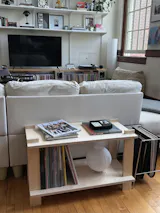
The first turntable stand most people buy is too big. The second one is too cheap. By the third — if there is a third — the answer becomes obvious: the right stand is small, sturdy, made of real wood, and probably not in the "audio furniture" category at all.
This is a guide to small turntable stands — what to look for, what to avoid, and the specific dimensions that make a stand actually work for a Pro-Ject Debut, Audio-Technica AT-LP120, Fluance RT85, or Rega Planar.
What "small" actually means
The audio furniture industry sells turntable stands at three sizes: cabinet (40″+ wide, holds receiver + 200 records), credenza (32-40″ wide, holds turntable + speakers), and side-table size (16-22″ wide, holds turntable + maybe 30 records).
 Same Baltic birch nightstand we sell as a bedside table — the dimensions are also right for most belt-drive and direct-drive turntables.
For a small apartment, a bedroom listening setup, or a one-turntable-and-a-pair-of-bookshelf-speakers configuration, the side-table size is what you want. Most turntables are smaller than people think:
Every one of those decks fits on a stand with an 18″ × 14″ top. Anything wider is wasted space; anything narrower is a fit problem.
"A turntable is 16-17″ wide. The right stand is 18″ wide. Anything bigger is buying real estate you don’t need."
The five rules for a small turntable stand
Solid wood or 13-ply Baltic birch — not particleboard
Mass and density absorb the foot-traffic vibration that makes a stylus skip. Particleboard is too low-density and too low-mass; it actually amplifies low-frequency footsteps. Solid wood, butcher block, or 13-ply Baltic birch plywood all work. Anything labeled "engineered wood" or "MDF with veneer" doesn’t.
The right height to play standing or sitting
22-24″ tall is the sweet spot. Tall enough to cue a record at a party without crouching, low enough to operate from a sofa or chair. Avoid anything under 20″ (you’ll wreck your back) or over 28″ (you’ll be reaching up to drop the needle).
An open lower shelf for records
30 records standing upright take up about 5″ of horizontal space. A 14-18″ lower shelf holds 50-100 records, which is the right number to keep "currently spinning" titles where you can grab them. Closed cabinet doors mean you’ll never actually flip through them.
It has to be level — really level
This isn’t a feature you buy, it’s a setup step. A turntable that’s off by even 1° will play one channel slightly louder than the other, and a belt-drive deck will pull tempo. The stand’s top has to be flat, and the floor it sits on has to be flat — or you need shims.
Decoupled from the speakers
If your speakers sit on the same surface as the turntable, low frequencies travel through the stand and into the stylus. The fix is either putting the speakers on stands of their own, or buying a turntable stand mass-y enough to dampen the bass. A solid Baltic birch top does the job for a 25-watt setup; a particleboard one will not.
What we’d use: the Modern Nightstand
The UNFNSHED Modern Nightstand is a small turntable stand we use ourselves. The dimensions land exactly where you want them: 18″ wide top, 14″ deep, 22″ tall, with an open lower shelf that takes 30-50 records standing upright.

Why it works
- 13-ply Baltic birch top — dense enough to absorb foot-traffic vibration
- 18″ × 14″ surface fits Pro-Ject, Audio-Technica, Rega, Fluance, U-Turn decks
- Lower shelf holds 30-50 records standing
- 22″ tall — works for sitting or standing operation
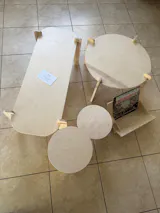
- Tool-free assembly, no screws to vibrate loose
- Unfinished birch lets you stain it to match your furniture or leave raw
What to know
- Decks wider than 18″ (Technics SL-1200, some DJ decks) won’t fit — look at the Modern Shelf instead
- Lower shelf is open — no door, no drawer (which is good for browsing, less good for dust)
- Single shelf — if you also want a phono pre + receiver, you’ll need to put them on the top with the deck or use a wider stand
What to avoid in a small turntable stand
IKEA Kallax (single-cube) on its side as a stand. Famous in the vinyl community, but the cube itself is hollow particleboard. It works for a few months until the screws strip and it starts to sag. Skip.
Mid-century modern reproduction stands from Wayfair. The teak veneer over MDF look-alikes weigh almost nothing, which means zero vibration damping. The stylus tracks the bass line of whatever’s playing.
Wire shelving. Visible flex when you set the platter spinning. The whole rig oscillates at 33⅓ RPM.
Vintage TV cabinets. They look great in photos. They are usually built from particleboard or hollow plywood with a wood veneer, and they sound bad. The exception: actual mid-century cabinets from the 50s-60s built from solid wood, but those run $400+.
Setup: three things that make any stand sound better
The bottom line
The best small turntable stand is the one with the right dimensions, made of real wood, at the right height. Skip the audio furniture markup — a 13-ply Baltic birch nightstand at $189 outperforms most "audio stands" at $400 because the underlying material is actually denser.
If you’re shopping today, the Modern Nightstand is the one we’d hand a friend setting up their first vinyl rig. 18″ × 14″ top, 22″ tall, holds 30-50 records on the lower shelf, ships flat from San Diego, assembles in under 5 minutes with no tools.
Turntable stand questions
What is the best small turntable stand?
The best small turntable stand has an 18-inch by 14-inch top (which fits Pro-Ject Debut, Audio-Technica AT-LP120, Rega Planar, Fluance RT81/85, and U-Turn Orbit), is 22-24 inches tall, and is built from solid wood or 13-ply Baltic birch — not particleboard or MDF. A lower shelf for 30-50 records is essential. The UNFNSHED Modern Nightstand at $189 hits all of these.
How tall should a turntable stand be?
22-24 inches tall is the sweet spot. It’s high enough to cue a record while standing without crouching, and low enough to reach from a sofa or chair. Below 20 inches is hard on your back; above 28 inches makes it awkward to drop the needle.
Will a Pro-Ject Debut fit on a nightstand?
Yes. The Pro-Ject Debut Carbon EVO measures 16.3 inches wide by 12.6 inches deep, which fits comfortably on any nightstand with an 18-inch wide top. The UNFNSHED Modern Nightstand has an 18-inch by 14-inch top and is built from 13-ply Baltic birch — dense enough to absorb foot-traffic vibration so the stylus doesn’t skip.
What kind of wood is best for a turntable stand?
Solid hardwood or 13-ply Baltic birch plywood are the best options for a turntable stand. Both are dense enough to absorb low-frequency vibration and stable enough to stay flat over time. Avoid particleboard, MDF, or hollow-core engineered wood — these amplify vibration rather than damping it.
How do I stop my turntable from skipping when people walk?
Three fixes. First, put the turntable on a stand made from solid wood or 13-ply Baltic birch — the mass damps foot-traffic vibration. Second, level both the stand and the platter using a bubble level. Third, add isolation feet (cork or sorbothane pucks) under the turntable to decouple it from the stand surface.
If your turntable shares a desk with a monitor, the wood monitor stand in matching Baltic birch frees up surface room beneath without clashing materials.
For records that don't fit on the stand itself, a 30" or 46" wood wall shelf mounted just above keeps a curated rotation at arm's reach in the same Baltic birch.