




Your nightstand has one job: hold the things you need between getting into bed and falling asleep. Phone, charger, water glass, lamp, and whatever book you're pretending to read. That's roughly 14 by 14 inches of stuff, maximum. So why do standard nightstands measure 21 to 28 inches wide and 16 to 20 inches deep?
In a small apartment bedroom, a standard 24-inch-wide nightstand can block the path between your bed and closet entirely. If your bed is pushed against a wall (and in a small apartment, it probably is), you might only have one side to work with. That side needs to handle everything. Here are seven rules for picking a nightstand for a small apartment that earns its footprint without stealing your floor space.
Measure the Gap, Not the Room
Forget the total square footage. The only number that matters is the gap between your bed and whatever is next to it. The wall, the closet door, the radiator, the second bed if you're sharing a room.

Grab a tape measure. Check the distance from the edge of your mattress to the nearest obstacle. Subtract 2 inches (you want that clearance between the nightstand and mattress edge so you're not knocking things off when you roll over). What's left is your maximum nightstand width.
If you have 14 inches of space, a standard nightstand at 24 inches wide is a non-starter. You need something in the 10 to 12 inch range. If you have 18 to 20 inches, you have more options, but you're still well below standard dimensions. Most small apartment nightstand solutions live in the 10 to 16 inch width range.
Go Tall and Narrow, Not Wide and Shallow
In a tight bedroom, vertical storage wins. A tall, narrow nightstand with a 12-inch footprint can hold just as much as a wide one if it uses height to its advantage. Stack your storage vertically: lamp on top, book on a lower shelf, phone and charger on the surface.
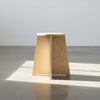
Our Nightstand is built with this principle in mind. It's sized to function as real bedside storage without the oversized footprint of furniture designed for master bedrooms. 13-ply premium-grade plywood, tool-free assembly in under 2 minutes, and it ships unfinished so you can match it to your bedroom's existing look.
Consider the Wall-Mounted Option (But Know the Trade-offs)
Floating or wall-mounted nightstands eliminate floor space usage entirely. That sounds perfect for a small apartment. And for some situations, it is. You gain floor space, the room looks cleaner, and your robot vacuum can actually reach under the bedside area.
But there are real downsides. Wall-mounted shelves require drilling into studs or using heavy-duty anchors, which not every landlord allows. They're fixed in place, so when you rearrange your bedroom (and you will), they stay where they are. And most floating nightstands max out at about 5 to 8 pounds of capacity, which means your hardcover, water glass, and lamp are pushing the limits.
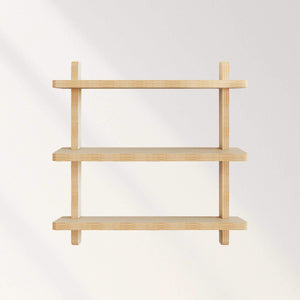
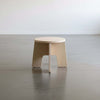
If you rent and can't drill, or if you rearrange often, a compact freestanding piece like the Mini Side Table gives you similar space savings without the commitment. It's small enough to tuck beside any bed, and because it assembles without tools, you can move it whenever the layout changes.

"A nightstand in a small apartment isn't about storage capacity. It's about holding exactly five things: phone, charger, water, lamp, and one item you'll pick up before sleep. If it does that without blocking your path to the bathroom at 2 a.m., it's the right size."
If Your Bed Is Against a Wall, Your Options Change
In a small apartment, pushing the bed against the wall is standard. It opens up floor space for everything else. But it also means you only have one accessible side for a nightstand, and that side is doing all the work.
For the wall side, a clip-on bedside caddy or shelf that attaches to the bed frame uses virtually no space. It holds a phone and a glass of water, and that's enough for the side you climb over anyway.
For the accessible side, that's where a proper small apartment nightstand goes. This is where the lamp lives, where the charger plugs in, where you set your glasses before sleep. Invest in the right piece here. A compact nightstand or mini side table in the right dimensions will handle everything without crowding the walkway.
The Surface Needs to Match the Bedroom, Not a Catalog
Small apartment bedrooms come in every shade of rental beige and gray. Pre-finished nightstands in "espresso" or "white oak" look great in product photos but might clash with your actual walls, flooring, and bedding.
Unfinished wood gives you control. Paint it matte black for a moody look. Stain it warm walnut to match mid-century pieces. Leave it raw for that Japandi, minimalist feel. When you move to a new apartment with different lighting and different walls, sand it lightly and refinish. Try doing that with laminate.
13-ply premium-grade plywood has a clean, tight grain that takes stain and paint evenly. It's also structural-grade, so it won't sag or warp from the humidity of a small bedroom with limited airflow. That matters more than you'd think.
Pick a Nightstand You Can Move in 30 Seconds
Small apartments demand flexibility. Your nightstand needs to move when you vacuum, when guests sleep over, when you decide the bed looks better on the other wall. If it's heavy, requires tools to disassemble, or has drawers that fall out when tilted, it becomes permanent furniture in a space that needs temporary solutions.
Our pieces use a tool-free interlocking joint system. Slide the panels together, they lock. Pull them apart, they store flat. The whole process takes under 2 minutes. That's the kind of thing that matters when you're rearranging at 10 p.m. on a Tuesday because the current layout is driving you crazy.
Know When a Nightstand Isn't the Right Call
Sometimes the honest answer is that a traditional nightstand doesn't fit. If you have less than 8 inches between your bed and the wall, no freestanding nightstand is going to work without blocking something.
Alternatives that actually function in tiny spaces:
- A folding stool: Works as a bedside table, folds flat and slides under the bed when you need floor space.
- Nesting tables: Use the smaller one as a nightstand, tuck it into the larger one during the day or when guests come over.
- A clip-on shelf or caddy: Attaches to the headboard or bed frame. Holds a phone and water glass. Uses zero floor space.
But if you have 10 or more inches to work with, a purpose-built compact bedside table will always outperform a workaround. It's more stable, holds more weight, and looks like something you chose on purpose rather than something you improvised.
Two Nightstands for Two Different Apartment Layouts
The Nightstand
Full bedside storage for apartments where you have 14+ inches of clearance beside the bed. 13-ply premium-grade plywood, tool-free assembly under 2 minutes, ships unfinished. Holds a lamp, books, and everything else. Made in San Diego.
Mini Side Table
For tighter spaces where 10 to 14 inches is all you've got. Same premium-grade plywood construction, same tool-free assembly. Smaller footprint, but still holds a lamp, phone, and water glass without feeling like a compromise.
Side Table
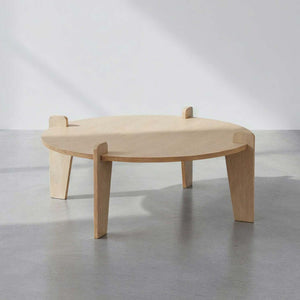
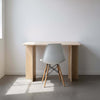
If your nightstand also needs to function as a small surface for other tasks. Versatile enough to work beside a bed, a couch, or a reading chair in a studio where one piece does multiple jobs.
FAQ
What size nightstand works in a small apartment bedroom?
Most small apartment bedrooms need a nightstand between 10 and 16 inches wide and under 14 inches deep. Measure the gap between your mattress edge and the nearest wall or obstacle, then subtract 2 inches for clearance. That's your maximum width. Standard nightstands at 21 to 28 inches wide are typically too large for tight bedroom layouts.
Should I get a wall-mounted nightstand for a small apartment?
Wall-mounted nightstands save floor space, which is great. But they require drilling into walls (not always allowed in rentals), they're fixed in place when you want to rearrange, and they typically support less weight than freestanding options. A compact freestanding nightstand or mini side table gives you similar space savings with more flexibility, especially if you move apartments frequently.
Can I use a nightstand as a side table in a studio apartment?
Absolutely, and you should. In a studio where your bedroom area flows into your living space, a compact nightstand beside the bed can double as an end table for seating nearby. Choose something in unfinished wood so you can finish it to match both your bed and your living room furniture. Pieces with tool-free assembly make it easy to reposition as your layout changes.