Your record collection might be worth more than your couch. Maybe a lot more. And yet most people drop $800 on a sofa they tested in-store, then grab a $60 particle board turntable stand off the internet without checking a single spec. A proper record player stand for living room use has to do three things at once: hold serious weight, isolate your turntable from vibration, and look like it belongs in the room where you spend most of your waking hours. Here are seven rules that separate a real vinyl setup from a wobbly regret.
7 Rules for Choosing a Record Player Stand for Your Living Room
Do the Weight Math First
Every LP weighs roughly half a pound. That adds up faster than people expect. A modest collection of 200 records puts 100 lbs on your vinyl storage furniture before you even count the turntable, receiver, or speakers sitting on top.

Particle board and hollow-core MDF start sagging under sustained loads like this. They were designed for light, evenly distributed weight, not 28 linear inches of densely packed vinyl. 13-ply premium-grade plywood handles this load without flinching because the cross-grain lamination distributes weight across all 13 layers. That is not marketing. That is material science.
Measure for the Dust Cover, Not Just the Turntable
This is the mistake that burns first-time buyers. You measure your turntable footprint, find a stand that fits, and then realize the dust cover lid needs 14 to 18 inches of vertical clearance above the platter to open fully. If there is a shelf above your turntable platform, your lid either cannot open or it slams into the shelf every time you flip a record.
Any record player stand worth buying should give you at least 16 inches of clear vertical space above the turntable surface. If the stand has an upper shelf, make sure it is high enough or removable.
Depth Matters More Than Width
Most turntables need 14 to 16 inches of depth. Go under 15 inches and you run into two problems: the cables behind the turntable get kinked against the wall, and the dust cover cannot open without the hinge hanging off the back edge.
Standard record player stands run 15 to 18 inches deep. That extra depth also gives you 4 inches of clearance behind the unit for cable routing and ventilation, which is critical if you are housing an amplifier that generates heat.
Keep Records Vertical. Always.
Stacking records flat warps them. This is not a matter of opinion. Vinyl under sustained pressure from its own weight will slowly deform, especially in a living room that gets afternoon sun and the temperature swings that come with it.
A good vinyl record shelf keeps LPs standing upright with enough support that they do not lean past 10 to 15 degrees. Each record is about 0.14 inches thick, which means 200 records need roughly 28 inches of linear shelf space to stand comfortably without being crammed.
Think About Vibration Like an Audiophile
Your turntable reads a groove that is fractions of a millimeter wide. Any vibration that reaches the stylus becomes noise in your speakers. Footsteps, bass from the subwoofer, even a slammed door can feed back through the stand and into your music.
This is where material choice becomes an audio decision, not just a furniture decision. MDF transmits vibration efficiently because it is a uniform, dense slab. premium-grade plywood, with its alternating grain layers, naturally dampens vibration because each ply interrupts the energy transfer of the one below it. Thirteen layers of cross-grain dampening between your floor and your stylus. That is the difference between hearing the record and hearing the room.
Leave Room to Breathe
Turntables need 1 to 2 inches of clearance on all sides for airflow and cable routing. If your turntable stand fits the deck like a glove, you have a problem. Tight fits trap heat from nearby electronics, make cable management impossible, and turn routine tasks like adjusting the tonearm counterweight into a knuckle-scraping ordeal.
For living room placement specifically, leave 4 inches between the back of the stand and the wall. This gives your cables room to curve naturally instead of crimping at sharp angles, and lets air circulate behind any amplifier or receiver you have tucked inside.
Your Living Room Deserves Better Than "Close Enough"
A record player stand lives in the middle of your most visible room. It sits next to furniture you chose carefully. It holds a collection you have spent years (and real money) building. "Close enough" on the color or finish is not actually close enough.
Pre-finished furniture locks you into whatever shade of walnut-tone laminate was trending when it shipped from the factory. Unfinished furniture lets you match the stand to your actual room. Stain it to match your floors. Paint it to match your walls. Oil it for a natural look that pairs with mid-century pieces. Or leave it raw if your aesthetic runs Scandinavian or minimal. We wrote a full guide on 7 easy ways to paint unfinished wood furniture if you want step-by-step options.

The Right Record Player Stand for Your Collection Size
Your collection size determines what you need. Here is how it breaks down:
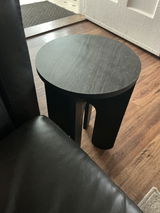
Under 100 records: A compact turntable stand (24 to 30 inches wide, 14 to 16 inches deep, 26 to 30 inches tall) handles your collection with room to grow. The Record / Book Holder works well here, keeping your most-played records within arm's reach of your setup.
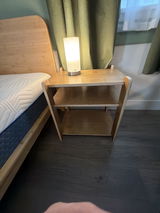
100 to 400 records: You need a standard Modern Nightstand in the 36 to 48 inch width range with dedicated record storage below the turntable platform. At this collection size, weight capacity and shelf reinforcement are non-negotiable. This is where 13-ply premium-grade plywood pays for itself, because a shelf holding 200 records is holding 100 lbs on a single span.
400+ records: You are beyond single-stand territory. Pair a Modern Nightstand for your active listening stack with additional Record / Book Holders for overflow storage elsewhere in the room.
"A record collection is not just media. It is weight, dimension, and value. The furniture holding it should be engineered for all three."
Why Premium-Grade Plywood for Vinyl Storage Furniture
Most turntable stands are built from MDF or particle board with a vinyl wrap. They look fine in photos. In person, they feel hollow. Tap the top surface and you hear it. That hollow resonance is exactly what your stylus picks up from the shelf below.
premium-grade plywood is a different material entirely. Each of the 13 plies is solid birch, not filler. The cross-grain construction makes it strong in every direction, which is why it has been the standard in speaker cabinets, studio furniture, and professional AV racks for decades. It handles sustained heavy loads without deflection and dampens vibration through its layered structure.
Every UNFNSHED piece ships from San Diego, assembles in under 2 minutes with zero tools, and arrives unfinished so you control the final look. No Allen wrenches. No plastic cam locks. No 47-step instruction booklet. Just interlocking joints that hold firm. We have 1,060+ reviews and 94% of them are five stars. Browse the full record player stand collection or check out our guide to tool-free assembly to see how it works.
Frequently Asked Questions
How much weight can a record player stand hold?
A well-built turntable stand should handle at least 150 lbs. A collection of 200 records weighs about 100 lbs on its own, and a turntable plus amplifier adds another 25 to 55 lbs. Stands made from 13-ply premium-grade plywood handle these loads without shelf sag. Particle board and MDF stands often start bowing under sustained loads above 60 to 80 lbs.
What size record player stand do I need for my living room?
For collections under 150 LPs, a compact stand (24 to 30 inches wide, 14 to 16 inches deep) works well and fits alongside most sofas and side tables. For 200+ records, look at standard sizes: 36 to 48 inches wide, 15 to 18 inches deep, 28 to 32 inches tall. Always measure your turntable footprint and add 1 to 2 inches on each side for clearance, and confirm you have at least 16 inches of vertical space above the platform for the dust cover.
Does the stand material actually affect turntable sound quality?
Yes. The stylus on a turntable is sensitive enough to pick up vibrations transmitted through the stand itself. MDF and particle board are uniform-density materials that transmit vibration efficiently. premium-grade plywood, with 13 alternating cross-grain layers, interrupts vibration transfer between plies. This natural dampening reduces feedback noise, which is why recording studios and audiophile setups have used birch plywood for equipment furniture for decades.