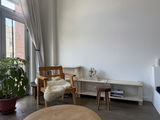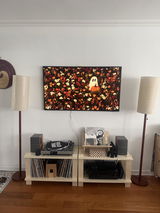





Most home office shelving advice focuses on making your space look good. That's backwards. Your office shelves aren't decorative. They're operational infrastructure. The shelf behind you is your Zoom background. The shelf beside you is your supply station. The shelf above your monitor holds the reference material you grab six times a day.
62% of employees report feeling more productive at home. But that number only holds if your workspace is set up with intention, not just aesthetics. The difference between a productive home office and a frustrating one often comes down to where you put things, and whether you can reach them without standing up.
The "Reach Zone" Framework for Home Office Shelving
The concept is simple: organize items by how often you use them. Things you grab 10+ times a day should be within arm's reach. Things you need weekly can go higher or further away. Things you rarely touch belong in a closet, not on a shelf.

This is called reach zoning, and it changes how you think about shelves for home office setups entirely. Instead of asking "where does this look best," you ask "how often do I grab this?"
Here's how it breaks down in practice:
- Primary zone (arm's reach, 18-30 inches from your seated position): Headphones, notebook, pens, phone charger, coffee mug. A desk organization shelf or small wall shelf handles this.
- Secondary zone (standing reach, 30-60 inches): Reference books, backup supplies, printer paper, tech accessories. Wall-mounted shelving works perfectly here.
- Background zone (behind you or high up): Items that look good on camera, plants, books you rarely open, decorative objects. This is where aesthetics actually matter.

Dimensions That Actually Matter
Before you buy home office shelves, measure two things: your monitor position and your remaining wall space.
According to OSHA guidelines, your monitor should sit 20-40 inches from your eyes, with the top of the screen at or slightly below eye level (15-20 degrees below horizontal). Correcting monitor height and distance alone reduces neck and shoulder discomfort by 20-30% within a few weeks.
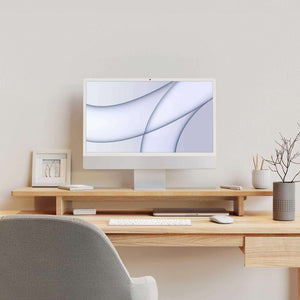
Why does this matter for shelving? Because the shelf above your desk needs to clear your monitor. And the shelf beside your desk needs to stay outside your peripheral vision so it doesn't compete with your screen.
Quick Measurements to Take Before Buying
- Desk depth: Standard is 24-30 inches. Deeper desks mean wall shelves need to be shallower or mounted higher.
- Monitor top height: Measure from desk surface to the top of your monitor. Your first shelf should clear this by at least 6 inches.
- Seated arm reach: Sit in your chair and extend your arm. Mark that distance. That's your primary zone boundary.
- Wall width beside desk: This determines whether you can fit a modular shelving unit to your left or right.
Three Home Office Shelving Setups
Setup 1: The Minimalist (Small Office or Apartment)
Best for: Desks against a wall with limited floor space.
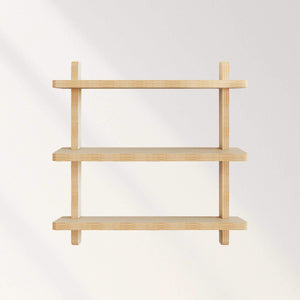
Mount a Double Modern Shelf directly above your monitor, 6-8 inches above the screen top. Use it for your most-grabbed items: headphones stand, a small plant, one reference book. Add a Wall Shelf to one side for supplies.
Total wall usage: Under 4 square feet. Keeps your desk surface completely clear except for your monitor, keyboard, and mouse.
Setup 2: The Builder (Dedicated Home Office)
Best for: A room where you work 30+ hours per week.
Start with a Modular Modern Shelf beside your desk as your reach zone station. Stack a Large Modern Shelf above your desk for secondary storage. Use the modular system so you can reconfigure as your workflow changes. One shelf becomes your tech dock (speakers, home assistant, chargers). The other holds files and reference material.
Total wall usage: 6-10 square feet. Replaces the need for a filing cabinet or bookcase.
Setup 3: The Zoom Professional (Camera-Facing Setup)
Best for: Anyone on video calls 5+ hours per week.
The wall behind you is real estate. Mount a Modular Wall Shelf system behind your chair, centered in your camera frame. Style it intentionally: a few books (spines out), one plant, one personal item. Keep it sparse. Cluttered backgrounds are distracting on calls.
Then put your functional shelving beside you, outside the camera frame. That's where the messy, useful stuff lives.
Office Wall Shelves vs. Freestanding Bookcases
| Factor | Wall Shelves | Freestanding Bookcase |
|---|---|---|
| Floor space used | Zero | 2-4 sq ft |
| Flexibility | Mount at any height | Fixed shelf heights |
| Reach zone access | Customizable to your seated position | Bottom shelves wasted, top shelves too high |
| Zoom background | Clean, intentional look | Can look bulky on camera |
| Moving/reconfiguring | Requires new mounting | Just slide it |
| Weight capacity | Depends on wall anchoring | Generally higher |
For most home offices, wall-mounted office wall shelves win. They maximize vertical space, keep your floor open for your chair to roll, and let you position storage exactly where your reach zones demand it.
"A productive home office isn't about having more space. It's about putting the right things within reach and everything else out of sight."
Lighting and Shelf Placement
One detail most people miss: shelf placement affects your lighting. A shelf mounted too low above your desk can block overhead light and cast shadows on your workspace. Proper lighting reduces eye strain, and natural light is always ideal. If your desk faces a window, avoid putting shelves where they block that light. If your desk faces a wall, make sure your above-desk shelf is high enough (at least 18 inches above the desk surface) to let light through.
Why Premium-Grade Plywood Works for Office Shelves
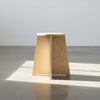
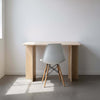
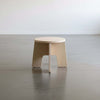
Our shelves are made from 13-ply premium-grade plywood, cut and assembled in San Diego. They ship unfinished so you can paint them to match your office, stain them for a warmer look, or leave them raw if you like the natural plywood aesthetic. Every piece assembles in under two minutes with zero tools, using an interlocking joint system. No Allen wrenches. No leftover mystery screws.
For home office storage specifically, the modular options let you start with one shelf and expand as your setup evolves. Most people's home offices change every 6-12 months as their work changes. Modular shelving adapts with you.
Our Home Office Shelf Picks
- Double Modern Shelf - Compact above-desk option for the primary reach zone
- Large Modern Shelf - Bigger footprint for secondary storage and reference materials
- Modular Modern Shelf - Expandable system that grows with your office
- Modular Wall Shelf - Perfect for Zoom background walls
- Wall Shelves - Simple, clean wall-mounted storage
Browse the full shelf collection | See all home office furniture