Small offices have a storage problem. You need places for books, supplies, samples, and the random stuff that accumulates over months of actually working — but filing cabinets and closed storage make small spaces feel even smaller. Every bulky cabinet you add shrinks the room a little more, both physically and visually.
The solution is open shelving. But it has to look intentional — not like a garage, not like a dorm room, and definitely not like you raided a big-box office supply store. Here's how to do it right.
Why Open Shelving Works Better in Small Offices
Closed storage hides things, which sounds great until you realize it also hides square footage. A solid bookcase or filing cabinet is a visual wall. Open shelving does the opposite — it lets your eye travel through the room, which makes tight spaces feel significantly bigger than they are.
Open Shelving
- Preserves sightlines and room depth
- Forces you to stay organized
- Doubles as display and storage
- Rearrange in thirty seconds
- Makes small rooms feel bigger
Closed Cabinets
- Blocks sightlines like a wall
- Hides clutter (and lets it grow)
- Storage only — no visual appeal
- Heavy, hard to rearrange
- Shrinks small rooms further
If you're not sure about the modular approach yet, this breakdown of modular vs. fixed shelving covers why traditional bookcases are harder to live with than they should be.
Five Shelving Setups for Small Offices

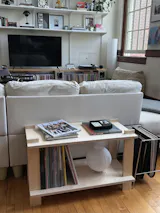
Modern Shelf — perfect for small office storage
Not every office needs the same thing. A solo freelancer working from a spare bedroom has different needs than a small retail shop. Here are five setups, each with specific product recommendations based on what actually works.
The Freestanding Bookshelf
This is the workhorse. A single Modern Shelf handles books, binders, supplies, and whatever else you need off your desk and off the floor. It doesn't require drilling into walls, which matters if you're renting or if you change your mind about layout every few months.
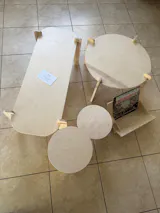
Because it assembles without tools — slot joints, no screws — you can move it around until you find the right spot. Against a wall behind your desk, next to a door, in a corner. It takes about two minutes to set up and zero minutes to rearrange.
It also works as a room divider in open-plan offices. Put it between two work areas, and you get separation plus storage without building a wall.
The Expandable Storage System
If you're not sure how much storage you'll need six months from now, start with a Modular Shelf. It begins as a single unit and grows by adding sections. Buy one now, add another when your book collection doubles or your supply inventory expands.
If you already know you need serious storage from day one — maybe you're setting up a studio or a small office library — skip straight to the Modular Shelf. It has the capacity without the gradual buildup.
Either way, modular systems make more sense for offices that are still evolving. There's a deeper look at small space furniture solutions if you're working with a particularly tight footprint.
Wall-Mounted Shelves
When floor space is genuinely limited — think home offices carved out of hallways, closets, or corners — wall-mounted shelves free up every square inch of floor.
Wall Shelves are the straightforward option. They mount above desks, in entryways, or in any spot where freestanding furniture simply won't fit. Clean lines, minimal hardware, no wasted space.
Wavy Wall Shelves do the same job with more personality. If your office leans creative — design studio, photography business, anything where the space itself is part of your brand — these add visual interest without looking like you're trying too hard.
For longer walls, the Wall Shelves is a system that grows horizontally. Start with one section, add more as needed. It keeps the wall looking cohesive instead of like a random collection of floating shelves.
The Display Shelf
Some businesses need shelving that does more than store — they need it to sell. Cafes displaying retail products, studios showing samples, showrooms presenting inventory. In these cases, the shelf is the merchandising.
Open shelving turns inventory into decor. A row of products on a well-lit shelf looks intentional and curated. The same products behind a glass cabinet look like a museum exhibit nobody asked for.
Check the Display Shelves collection for options built specifically for this use case. If you're running a cafe or retail space, the Coffee Shop Shelves collection is worth a look too — same concept, styled for commercial spaces.
The Desk-Adjacent Setup
This one is less about a single piece and more about a system. Place a Modern Shelf right next to your desk so it functions as an extended workspace. Reference books, active project folders, supplies — everything within arm's reach without cluttering your actual desk surface.
Pair it with a Monitor Stand on the desk itself. Raising your monitor clears the surface underneath for notebooks, a keyboard, or just empty space. The combination — elevated monitor, clear desk, storage within reach — makes a small office feel like it has twice the workspace.
The goal is simple: everything you need is accessible, nothing is piled on top of something else, and your desk stays functional instead of becoming a storage unit with a laptop on it.
How to Make Open Shelving Look Good (Not Cluttered)

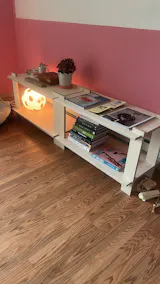
Large Modern Shelf — for offices that need more capacity
Open shelving only works if it looks organized. A messy open shelf is worse than a messy cabinet because everyone can see it — including you, all day. Here are the rules that actually matter:
Filing Cabinets Are Dead

Wall Shelves — floating storage that saves floor space
Filing cabinets were designed for paper offices. Rows of manila folders, tax documents, client files — that was the world they were built for. Most small businesses today are digital-first. Your files live in the cloud, your invoices are PDFs, your contracts are signed electronically.
What you actually need to store in a physical office is different now: books, product samples, supplies, a printer, equipment, personal items. None of that fits well in a filing cabinet. It fits perfectly on shelves.
And shelves don't make your office look like a government building from 1997.
Set Up Your Office
If you're putting together a small office — or redoing one that's not working — start with the collections below. Everything is designed for small spaces, assembles without tools, and ships flat.
Good shelving won't fix a bad layout. But in a small office, it's the difference between a space that works and one that feels like it's closing in on you.