

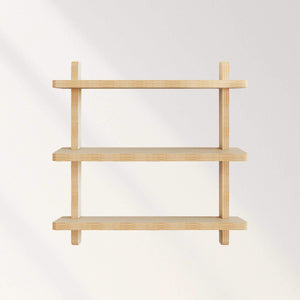



Upper kitchen cabinets do their job, but they also make kitchens feel smaller, darker, and more closed off. There's a reason every kitchen renovation on the internet features open shelving: it makes the room breathe. A wall shelf for kitchen use puts your best dishes on display, keeps everyday items within arm's reach, and opens up sightlines that upper cabinets block entirely.
But open shelving isn't just an aesthetic swap. Depth, weight capacity, and material choice all matter more in a kitchen than in a living room. Here's what you need to know before you commit.
Why Open Shelves Instead of Upper Cabinets
Upper cabinets hide everything. That's their design intent, and it works if your kitchen items are mismatched and you'd rather not see them. But if you own dishes, mugs, or glassware worth looking at, cabinets are doing you a disservice.

Open wall shelves accomplish three things cabinets can't:
- They make a small kitchen feel bigger. Removing even one run of upper cabinets and replacing them with floating shelves opens up the visual depth of the room. Your eye travels to the wall behind the shelf instead of stopping at a cabinet door.
- They keep frequently used items accessible. No more opening a cabinet, scanning three stacked rows of mugs, and pulling one from the back. Everything is right there, face out.
- They force you to curate. Open shelving means you only keep what you're willing to display. The chipped mug from 2014 and the novelty shot glass collection either get donated or moved to a closed cabinet elsewhere. What stays on the shelf is intentional.
"Upper cabinets store things. Open shelves display them. That one distinction changes how your entire kitchen feels."

The Depth Question: 6 Inches vs. 8 vs. 10 vs. 12
Shelf depth is where most people get kitchen open shelving wrong. A shelf that's too shallow won't hold dinner plates. A shelf that's too deep sticks out into your workspace and collects dust behind the items in front. Here's the breakdown by what you're storing.
| Shelf Depth | What It Holds | Best For |
|---|---|---|
| 6 inches | Spice jars, small bottles, shot glasses | Narrow walls, above-window displays, spice racks |
| 8 inches | Coffee mugs, drinking glasses, small bowls | The most versatile depth for daily kitchen use |
| 10 inches | Dinner plates (standing upright or stacked 3-4 high), mixing bowls | Primary dish storage replacing upper cabinets |
| 12 inches | Large serving platters, cookbooks, small appliances | Deep shelves above counters with clearance |
If you're only installing one shelf, 8 inches is the safest depth. It holds mugs, glasses, and small bowls without protruding too far from the wall. If you're going all-in on open shelving and replacing a full run of upper cabinets, you'll want at least 10-inch depth for the primary shelf where plates live.
Weight Capacity: Can a Floating Shelf Hold Dishes?
This is the question people ask most, and the answer depends entirely on two things: what the shelf is made of and how it's mounted.
Weight Capacity Factors
- Material matters. A 13-ply premium-grade plywood shelf is structurally stronger than MDF of the same thickness. The cross-laminated plies distribute load across the entire shelf rather than concentrating stress at the mounting points. MDF is dense but brittle under load; it can snap if overloaded, especially at longer spans.
- Mounting is everything. A shelf is only as strong as what's holding it to the wall. Hit studs, not just drywall. Two mounting points on studs will hold 40-60 lbs depending on the bracket. Drywall anchors alone max out around 15-20 lbs and will eventually pull out under sustained load from stacked ceramics.
- Span length affects sag. A 24-inch shelf can hold significantly more weight per inch than a 48-inch shelf of the same material. Longer spans need either thicker material, a center support, or lighter items. For heavy dish storage, keep individual shelf runs under 36 inches or add a center bracket.
A standard set of 4 dinner plates weighs about 8-10 lbs. A row of 6 coffee mugs adds roughly 4-6 lbs. Even a fully loaded 36-inch kitchen shelf with plates, mugs, and a few bowls rarely exceeds 25 lbs, well within the capacity of a properly mounted premium-grade plywood shelf on studs.
Styling Kitchen Shelves Without the Clutter
The fear with open kitchen shelving is that it'll look messy. Fair concern. But clutter on open shelves is a curation problem, not a shelving problem.
Rules that keep kitchen shelves looking sharp:
- Group items by category: mugs together, plates together, glasses together. Mixed-use shelves look chaotic.
- Stack plates no higher than 4-5. Taller stacks look unstable and make it hard to grab the bottom plate.
- Keep one decorative element per shelf: a small plant, a cookbook leaned against the wall, or a ceramic pitcher. One, not four.
- Leave 15-20% of the shelf surface empty. The negative space is what makes it look designed rather than crammed.
Unfinished premium-grade plywood pairs particularly well with white ceramics and stoneware. The warm, light wood tone creates contrast without competing with the items on display. If your kitchen skews darker, a matte black paint or an ebony stain on the shelf creates a gallery-like backdrop for lighter dishes. Our guide to painting unfinished wood furniture covers every finish option.
Material Deep Dive: Why Premium-Grade Plywood Works in Kitchens
Kitchens are hard on materials. Heat from stovetops, moisture from boiling pots, occasional splashes of oil and water. The shelf material you choose needs to handle all of it without degrading.
13-ply construction means each UNFNSHED shelf has 13 alternating layers of birch veneer, each ply running perpendicular to the last. This makes the shelf dimensionally stable in humidity, resistant to warping, and significantly stronger than single-layer MDF at the same thickness. It's the same material used in professional cabinetry, aircraft interiors, and high-end speaker enclosures.
For a deeper look at why plywood outperforms other engineered woods, our piece on plywood furniture, beauty, quality, and iconic design covers the history and engineering.
UNFNSHED shelves ship unfinished from San Diego, assemble in under two minutes with no tools, and carry 1,060+ reviews with 94% at five stars. For kitchen use, we recommend sealing with a food-safe finish like mineral oil or water-based polyurethane before mounting.
Kitchen-Ready Wall Shelves
- Wall Shelves - Clean, straight profile. Ideal for single-shelf installations above the counter or replacing one section of upper cabinets.
- Modular Wall Shelf - Start with one unit and expand. Perfect for building a full open shelving wall incrementally, one shelf at a time.