Japandi is not a color palette or a collection of decorating rules. It is a set of proportional relationships -- between negative space and filled space, between object weight and visual lightness, between how much a piece does and how little it appears to do. Apply those relationships to a bookshelf and you get something that looks specific and intentional. Ignore them and you get a generic modern shelf that a lot of people buy thinking it is Japandi.
This is a guide to the dimensions and material choices that make the difference. We will use the UNFNSHED Modular Shelf as the reference piece because its proportions were designed with exactly this problem in mind.
The Proportion That Most People Get Wrong: Depth-to-Height Ratio
A shelf that reads as Japandi is typically shallow relative to its height. Deep shelves (14 inches or more front to back) pull objects forward visually and make the piece feel like storage. Shallow shelves (8-10 inches) push objects back and make the piece feel like display.
The Japandi sweet spot for a bookshelf is a depth-to-height ratio of roughly 1:8 to 1:12. A shelf that is 8 inches deep and 72 inches tall hits this range. One that is 14 inches deep and 72 inches tall reads as a utility shelving unit regardless of what you put on it.
The UNFNSHED Modular Shelf is 9.25 inches deep and available in 28-inch and 42-inch heights per unit. Stack two 42-inch units and you get an 84-inch shelf at a 1:9 depth-to-height ratio -- right in the Japandi zone.
Shelf Spacing: How Much Room Between Levels
Japandi shelving tends to have more open space per level than Western bookcases. The standard American bookcase gives you 10-12 inches of vertical clearance per shelf to fit paperbacks. A Japandi bookshelf gives you 12-15 inches to fit the same books plus a plant, a ceramic object, or enough air that the shelf does not look packed.
The Modular Shelf has 13.5 inches of clearance between shelves. That accommodates most hardcovers, vinyl records, small ceramics, and trailing plants without requiring any rearranging. It is also wide enough that a single shelf level looks intentionally sparse with just three or four objects on it -- which is the correct default for a Japandi display.
Material: Why Baltic Birch Works for Japandi

Japandi interiors favor materials that are visibly natural but not aggressively rustic. Heavily grained pine reads as Scandi cabin. White-painted MDF reads as IKEA. Baltic birch sits between those -- it has a light, consistent grain with fine figure, a pale warm tone, and enough surface variation to feel alive without dominating the room.
The grain on Baltic birch runs parallel and close together, which means the edge of a shelf (the part facing you when you look at it) shows a tight layered pattern rather than a raw end-grain mess. That edge detail is part of why furniture made from Baltic birch looks precise in a way that solid pine or MDF does not.
For finish: natural oil or clear matte sealant keeps the birch tone and grain. A white-matte paint reads more Scandinavian than Japanese. A dark stain (black, charcoal, or deep walnut) shifts the piece toward the Japanese side of Japandi and pairs well with ceramic objects and dried botanicals.
What to Put on a Japandi Bookshelf (and What to Take Off)

The rule most people hear is: put less on it than you think you need. That is correct but incomplete. The more specific version: group objects by weight class. Heavy (books, heavy ceramics, records) at the bottom. Medium (smaller ceramics, small plants, framed photos) in the middle. Light or empty (trailing plants, a single object, or nothing) at the top.
What consistently does not work on a Japandi shelf: colorful spines facing outward, mismatched frames, anything plastic or highly reflective, and objects at different heights on the same shelf level (this creates visual noise rather than the rhythm that makes Japandi shelving look intentional).
What works: books turned spine-in (pages facing out), a mix of books and one or two objects per shelf, plants at the top with trailing foliage, and consistent material families per shelf (ceramic and stone on one level, wood and plant on another).
Single Unit vs. Stacked: Which Configuration for a Japandi Bookshelf

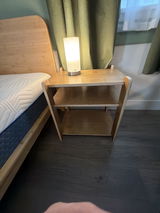
A single 28-inch unit works as a bedside display shelf or a low sideboard in a reading corner. A single 42-inch unit is the right height for a living room shelf that sits below a window or beside a sofa.
For a dedicated bookshelf -- one that actually holds books -- stack two units. Two 42-inch units give you 84 inches of usable height and five shelf levels. At 9.25 inches deep across 24 inches of width, two stacked units hold roughly 40-60 books depending on thickness, with room for display objects on at least two of the five levels.
The modular design means you can start with one unit and add a second unit later without buying a new piece of furniture. The joints connect without tools; adding a second unit takes about 10 minutes.
Putting It Together
The short version of what makes a bookshelf read as Japandi: shallow depth relative to height (depth-to-height ratio under 1:8), adequate vertical clearance per shelf (12 inches or more), a natural material with fine grain and a light or dark but not colorful finish, and restraint in what gets placed on it.
The Modular Shelf hits all of these by design. It is available as a single unit starting at $139 and ships flat with all joints pre-cut for tool-free assembly.