




A plywood stool sounds simple until you need it to do three different jobs in the same home. Counter height for the kitchen island. Desk height for the home office. Low enough to sit at a record player without craning your neck. Most stools solve one of those. This guide helps you solve all of them.
It covers how to choose the right seat height for every use, why plywood outperforms solid wood and solid wood alternatives, and what finish works where.
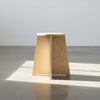
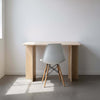
 Baltic birch at standard desk height. No tools, no hardware, no compromise on proportion.
Why plywood works better than solid wood for stools
Solid wood stools crack along the grain under point-load stress, which is exactly what a stool takes when someone shifts their weight. Baltic birch plywood cross-laminates alternating grain directions across 13 or more layers. There is no single weak direction. The seat stays flat, the legs stay true, and the whole thing holds its geometry through humidity changes that would split or warp a solid slab.
Weight also matters. A solid hardwood stool at counter height weighs significantly more than a plywood equivalent. That difference shows up every time you pull it out, slide it over, or move to a different room. Our No-Tool Stool is built from Baltic birch and assembles without hardware, which means you can break it down and move it in under two minutes.
MDF and particle board alternatives are lighter but not structural. They compress over time under consistent load and are not refinishable. Plywood is the only material that holds up, ages well, and can be oiled or stained to match the room it moves into.
"The right stool height is not a preference. It is a measurement. Get it wrong and you feel it in your shoulders inside an hour."
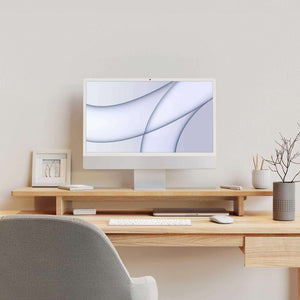
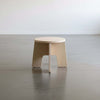
 Desk height at 17 to 19 inches works for most chairs. This one sits lower for a more grounded, floor-close feel.
Five setups, five heights
Standard desk (28 to 30 inches)
Seat height: 17 to 19 inches. This is the most common home office configuration. At 17 inches your feet are flat and your thighs are parallel to the floor. At 19 inches you get a slight forward tilt, which opens the hip angle and takes pressure off the lower back. If you are between 5 feet 4 inches and 6 feet this range covers you without adjustment.
Standing desk at sitting height (36 to 38 inches)
Seat height: 24 to 26 inches. Most standing desks lower to 28 or 30 inches, but the middle sit-stand configuration is 36 to 38 inches, and a 24-inch stool lets you perch without committing to a full sit. You can lean in, push off, and transition easily. This is the height that makes a standing desk actually useful rather than just tall.
Kitchen island or counter (36 inches)
Seat height: 24 to 26 inches. Counter-height stools at 24 inches leave your elbows at counter level with enough clearance to eat or prep without hunching. At 26 inches the posture opens and feels more casual. Most counter stools are 24 inches for that reason. If your island is 38 or 40 inches, go up to 28 inches.
Record player station (standard table or shelf, 28 to 32 inches)
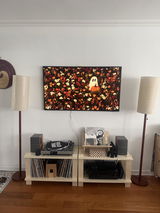
Seat height: 17 to 19 inches. The goal is to sit slightly below the turntable surface so you can see the needle drop without bending forward. Most record player setups sit on a shelf or low sideboard between 28 and 32 inches. A standard desk-height stool at 17 to 19 inches lands you at the right eye line without straining your neck. Avoid counter-height stools here: you will end up looking down at the platter and the posture is awkward for more than a few minutes.
Low work surface or 3D printer table (24 to 26 inches)
Seat height: 14 to 16 inches. Some workbenches, printer stations, and workshop tables are deliberately low to give leverage or access from above. At these surfaces a shorter stool or even a floor-level seat is right. Our No-Tool Stool is designed for the desk-height use case. For workshop-height setups, a lower platform or block stool is the right category.
 Counter height. The proportions change when you go taller: legs longer, seat narrower. Baltic birch stays rigid at both scales.
Plywood stool vs solid wood vs metal: which holds up
Plywood stool
- Cross-laminated grain resists cracking under point loads
- Holds flat through seasonal humidity changes
- Lighter than solid hardwood at equivalent dimensions
- Refinishable: oil, stain, or leave raw and let it patina
- Can be assembled or broken down without tools
- No weak direction along a single grain line
Solid wood or metal
- Solid wood splits along the grain under repetitive stress
- Warps or swells in humid rooms like kitchens
- Significantly heavier at counter and bar heights
- Metal is durable but cold, marks floors, and cannot be refinished to match a wood interior
- Mass-market solid wood is often low-grade pine or rubber wood, not hardwood
- Most solid stools are glued and dowelled, not tool-free
 Raw birch left unfinished develops a warm honey tone over 6 to 12 months. No maintenance required.
Finish guide for plywood stools in every room
Plywood stools: common questions
What height should a plywood stool be for a standard desk?
17 to 19 inches for a desk surface at 28 to 30 inches. At 17 inches your feet are flat on the floor and your thighs are parallel. At 19 inches the hip angle opens slightly, which reduces lower back pressure for longer sessions. If you are taller than 6 feet, lean toward 19 inches.
Is plywood strong enough for a stool?
Yes, and it outperforms solid wood in most structural respects. Baltic birch cross-lamination distributes load across alternating grain directions, which means there is no single weak axis. A Baltic birch plywood stool will not crack along the grain the way a solid wood stool can under repeated point-load stress.
What is the difference between a counter-height and desk-height plywood stool?
Seat height. A desk-height stool sits at 17 to 19 inches, matching a standard 28 to 30 inch desk surface. A counter-height stool sits at 24 to 26 inches, matching a 36-inch kitchen island or counter. Bar height stools at 28 to 30 inches are for bar-height surfaces at 40 to 42 inches. The proportions of the stool itself also change: counter and bar stools have longer legs and sometimes a narrower seat to account for the different center of gravity.
How do I finish a plywood stool to match my furniture?
Start with a water-based stain in the tone you want, then seal with a hardwax oil. Baltic birch takes stain evenly without blotching. Leave it a day between coats. If you want to keep the natural color, skip the stain and apply only the hardwax oil. Raw birch also patinas on its own to a warm honey tone over 6 to 12 months without any finish applied.
Does a plywood stool need to be anchored or braced?
No, a well-designed plywood stool is freestanding and stable at any of the standard seat heights. The joinery is the structural element. A stool that needs additional bracing or wall anchoring has a geometry or joinery problem, not a material problem. Baltic birch at appropriate thickness holds its shape without cross-bracing under typical seating loads.