Last spring, my friend Sara turned the unused guest bedroom in her apartment into a playroom for her three-year-old. She bought a pastel table-and-chair set from a big box store, a foam cube seat, and one of those fabric toy bins that collapses if you look at it wrong. Six weeks later, the table had permanent marker grooves, the chair legs were wobbly, and the foam cube smelled like applesauce. She'd spent $280 on kids furniture for playroom use that didn't survive a single San Diego summer. This is the reality nobody on Pinterest talks about.
Playrooms are destruction zones. That's their job. The furniture inside them should be built for exactly that, not styled around it. This guide walks through how to set up a playroom with furniture your kid will actually use, sized correctly for their body, and tough enough to take the daily beating that comes with being three feet tall and fearless.
Step One: Get the Table Height Right (Most Parents Don't)
Here's the number that matters most in any toddler playroom setup, and the one most parents get wrong: table height. Kids grow fast, and a table that's perfect at 18 months is useless by age four. The sizing breaks down like this:

The table-to-chair clearance matters too. You need 7 to 8 inches between the top of the seat and the underside of the tabletop. Less than that and your kid's legs are jammed. More than that and they're reaching up to color, which kills their posture and their patience.
Sara's first table was 20 inches high. Her daughter was two. The kid's feet dangled six inches off the ground. She squirmed constantly, knocked things over, and never sat for more than three minutes. Sara thought her daughter just didn't like coloring. Wrong. The furniture was wrong.
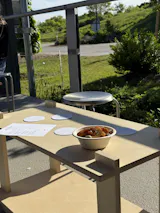
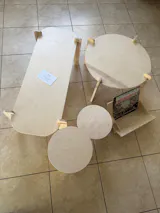
The UNFNSHED Kids Table and Chairs is sized for this exact age range. And because it's built from 13-ply Baltic birch plywood with tool-free assembly, Sara's daughter actually helped put it together. Interlocking joints, no screws, under two minutes. A three-year-old can do it. That's not marketing copy. That's a Tuesday afternoon.

Step Two: Accept That the Playroom Will Get Destroyed
Crayon on the table. Watercolor paint ground into the surface. Yogurt dried into the grain. Play-Doh in every crevice. If you've set up a playroom, you know this isn't hypothetical. It's Wednesday.
This is exactly why unfinished wood is a feature in a playroom, not a compromise. Most kids' furniture comes pre-coated in lacquer or paint. When that finish gets scratched or stained, you're done. You can't fix it without stripping the whole piece, and most parents just throw it away.
Unfinished Baltic birch plywood works differently. Crayon marks? Sand them out with 150-grit in about 30 seconds. Paint stain? Sand it. Mysterious sticky substance you'd rather not identify? Sand it. The surface resets every time. You can refinish it in whatever color your kid is obsessed with this month and sand it back again next year. Try that with a laminated particleboard table from Target.
"The playroom is the one room in your house where unfinished wood makes more sense than finished wood. Every scratch, stain, and mystery smear can be sanded out and started over. That's not a limitation. That's the whole point."
For finishing tips that are safe around small kids, our guide to safe wood finishing around kids covers zero-VOC options and natural sealants. And if your kid wants their table painted bright yellow this week, check out 7 easy ways to paint unfinished wood furniture.
Step Three: Build a Montessori Playroom Without the Montessori Price Tag
The core idea behind montessori playroom furniture is simple: everything should be child-sized so the kid can use it independently. Low shelves they can reach. A table they can sit at without help. A chair they can pull out themselves. The philosophy isn't complicated. The price tags usually are.
Sara built her daughter's playroom around four pieces, all from UNFNSHED, all under two minutes each to assemble:
Sara's Playroom Setup
- Kids Table and Chairs as the central work station for art, snacks, and puzzles
- Kids Bench along one wall for reading and putting on shoes
- Modern Shelf mounted low for front-facing book display and toy rotation
- Toddler Stool so her daughter could reach the bathroom sink independently
That's it. Four pieces. All 13-ply Baltic birch. All tool-free. Total assembly time was under eight minutes, and her daughter "helped" with three of them (mostly by sitting on the pieces before they were done, but still).
The shelf is the piece that made the biggest difference. When books and toys are at kid height, displayed with covers facing out, children actually choose them. When everything is stuffed into a bin or stacked on a shelf they can't reach, they default to whatever's on the floor. Montessori gets this right: accessible furniture creates independent kids.
Step Four: Add a Rocker (Trust Me)
Sara almost skipped this one. A rocking chair in a playroom felt like an afterthought. But the Mini Rocker turned into the most-used piece in the room. Her daughter sits in it to look at books, rocks while watching her tablet during allowed screen time, and retreats to it when she needs to decompress after a meltdown. Every playroom needs a spot that feels like "mine." A kid-sized rocker does that.
It's also the piece her daughter has personalized the most. They painted it together with milk paint (non-toxic, no off-gassing), and when the paint chipped after a few months of heavy use, they sanded it down and repainted it teal. Round two took 20 minutes.
The Playroom Furniture Checklist
- Table height matches your child's age bracket (12", 15", or 18")
- Chair seat height allows feet flat on floor with 90-degree knee bend
- 7-8" clearance between seat top and table underside
- At least one shelf mounted at child height for independent book/toy access
- A dedicated sitting spot that isn't at the table (bench or rocker)
- All surfaces are sandable or refinishable (no laminate, no vinyl wrap)
- Zero exposed hardware at kid height
- Furniture is light enough for the child to move but stable enough not to tip
UNFNSHED Kids Furniture for Playroom Spaces
Kids Table and Chairs
The center of any playroom. Sized for small bodies, built from 13-ply Baltic birch, and assembled without tools in under two minutes. Sand out the crayon damage as needed. Repeat forever.
Kids Bench
Reading nook, shoe-putting-on station, extra seating when friends come over. Low enough for toddlers, strong enough for parents to sit on too.
Toddler Stool
Independence in one step. Bathroom sink, kitchen counter, art easel. Light enough for a two-year-old to carry. Stable enough to stand on safely.
Mini Rocker
The quiet corner of the playroom. Perfect for reading, resting, and recovering from big feelings. Kid-sized. Parent-approved. Repaintable on demand.
Browse the full kids furniture collection or explore Montessori bookshelves for playroom storage.
Keep Exploring
Frequently Asked Questions
What height should a kids playroom table be?
Table height depends on your child's age. For babies 6 to 18 months, use a 12-inch table. For toddlers 1 to 3 years old, a 15-inch table is correct. For kids 3 to 6, go with 18 inches. The key measurement most parents miss is the clearance between the seat top and the table underside, which should be 7 to 8 inches. Chair seat height should let your child sit with feet flat on the floor and knees bent at 90 degrees.
Is unfinished wood furniture safe for a kids playroom?
Unfinished wood is actually one of the safest options for a playroom. There are no chemical coatings, no VOC off-gassing, and no lacquer that can chip into small pieces. Baltic birch plywood has a smooth, splinter-resistant surface. You can leave it raw or apply a non-toxic finish like milk paint, beeswax, or pure tung oil. The biggest advantage is repairability: scratches, stains, and crayon marks sand out completely, which means the furniture lasts years longer than pre-finished alternatives.
What furniture do you need for a Montessori playroom?
A Montessori playroom needs child-sized furniture that promotes independence. The essentials are a low table and chairs where the child can sit without help, a shelf mounted at kid height with toys and books displayed front-facing, and a step stool for reaching things just above their range. All furniture should be lightweight enough for the child to move but stable enough not to tip. The goal is a space where a toddler can choose activities, sit down, and clean up without asking an adult for help.