


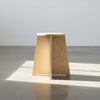
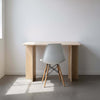
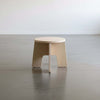


Traditional nightstands are 24 inches wide, 16 inches deep, and 26 inches tall. That's a substantial piece of furniture. In a bedroom with a queen bed, two of them eat up 4 feet of wall space and extend over 2.5 feet from the wall on each side. If your bedroom is under 12 x 12 feet, or if your bed is pushed against a wall, there's a good chance a standard nightstand doesn't fit without blocking a door, a closet, or a walkway.
A side table solves this. Same function, smaller footprint, more design flexibility. The trick is getting the height right.
The Problem: Standard Nightstands in Small Bedrooms
Here's what happens when you put a standard nightstand in a bedroom that's too small for it:

- The walkway between the bed and the wall drops below 24 inches, which means you're turning sideways to get into bed.
- The nightstand blocks the bottom drawer of your dresser from opening fully.
- One nightstand fits on the window side, but the other side is next to the closet door, so you either skip it or block the door.
- The room feels cramped before you've even added a lamp.
None of these problems are about needing a nightstand less. You still need a surface next to your bed for your phone, a glass of water, a book, and an alarm clock. The problem is dimensional: the traditional nightstand form factor assumes a bedroom big enough to accommodate it. Many bedrooms aren't.
The critical number: 24 inches. That's the minimum comfortable walkway width between your bed and the nearest piece of furniture. If adding a nightstand drops your walkway below 24 inches, you need a smaller piece. A side table with a 12-14 inch footprint preserves that clearance in rooms where a standard nightstand can't.

The Solution: A Side Table Sized for Bedside Use
A side table used as a nightstand needs to meet three criteria: the right height, enough surface area for bedside essentials, and a small enough footprint to preserve floor space.
Height: Match Your Mattress Top
The top of your bedside table should sit within 2 inches of the top of your mattress. This is non-negotiable for comfort. Too high and you're reaching up for your water glass in the dark. Too low and your alarm clock sits below your sightline, making it useless for checking the time without lifting your head off the pillow.
- Standard mattress on a bed frame: 23-26 inches from floor to mattress top. Your side table should be 23-28 inches tall.
- Platform bed with a thinner mattress: 18-22 inches from floor to mattress top. Look for a table in the 18-24 inch range.
- Mattress on the floor: 8-14 inches from floor to mattress top. You need either a very low table or a wall-mounted shelf instead.
Measure from the floor to the top of your mattress (not the pillow, not the headboard). Save that number. That's your target table height, plus or minus 2 inches.
What Actually Fits on a Compact Bedside Table
People overestimate how much surface area they need on a nightstand. Let's look at the actual dimensions of common bedside items:
| Item | Footprint |
|---|---|
| Smartphone | 3 x 6 inches |
| Glass of water | 3 x 3 inches |
| Paperback book | 5 x 8 inches |
| Small lamp base | 5 x 5 inches |
| Alarm clock | 4 x 3 inches |
A 12 x 12 inch table surface comfortably holds a phone, a glass of water, and a book. Add a small lamp and you need about 14 x 14 inches. That's it. The 24-inch-wide traditional nightstand gives you surface area you'll fill with clutter, not essentials.
"A smaller bedside table doesn't mean less function. It means less room for the stuff that doesn't belong next to your bed in the first place."
Why a Side Table Gives You More Design Flexibility Than a Nightstand
Traditional nightstands come with drawers. That sounds like a feature until you realize it locks you into a specific visual weight and style. A drawer unit next to your bed looks substantial, permanent, and matched-set. Sometimes that's what you want. But if your bedroom style leans minimal, or if you change your decor more than once a decade, a simple side table offers advantages.
- Visual lightness: A side table without drawers lets you see the floor underneath, which makes a small room feel larger. Closed nightstands create visual bulk that anchors the eye.
- Easy to move: A side table weighs a fraction of a drawer nightstand. Moving it for cleaning, rearranging, or taking to a new apartment takes 30 seconds.
- Finish flexibility: An unfinished wood side table can be painted, stained, or oiled to match any bedroom color scheme and repainted whenever you want a change. Our guide to painting unfinished wood furniture covers every technique.
- Asymmetry works: You don't need two matching pieces. A side table on one side and a wall-mounted shelf on the other creates visual interest without the matchy-matchy hotel room feel.
Style Direction: Japandi Bedrooms and Natural Wood
If you're building a bedroom with japandi, Scandinavian, or minimalist influences, a natural wood side table next to the bed is the default move. The warmth of unfinished premium-grade plywood pairs naturally with linen bedding, neutral wall colors, and simple textiles. The visible grain adds texture to a room that might otherwise feel flat.
For a full japandi bedroom strategy, our japandi style on a budget guide covers bed frames, lighting, and furniture selection room by room.
The Right Side Tables for Bedside Use
UNFNSHED side tables are cut from 13-ply premium-grade plywood in San Diego, assemble in under two minutes with no tools, and ship unfinished. With 1,060+ reviews and 94% of them five stars, they're proven in real bedrooms across the country.
Side Tables That Work as Nightstands
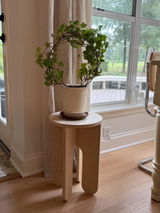
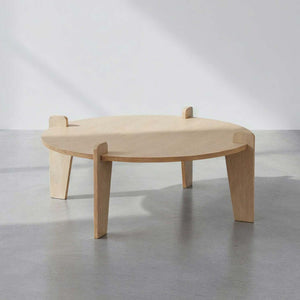
- Side Table - Standard footprint, ideal height range for most bed and mattress combinations. Enough surface for a lamp, phone, and water glass with room to spare.
- Mini Side Table - Compact footprint for bedrooms where every inch matters. Fits in the narrow gap between a bed frame and a wall or closet door. Holds the essentials without crowding the walkway.