







Particle board desks look the same as plywood desks at the point of sale. Both are flat, both are rectangular, both come in matte finishes that photograph similarly on a white background. The difference is not visible in a product photo. It shows up when you cable-route underneath and a screw does not hold, when the surface dents from a dropped stapler, or when you move the desk three years later and the legs wobble because the particleboard housing has started to delaminate at the joints.
This guide explains what makes a plywood desk different and what to look for when the spec sheet uses vague language about materials.
Plywood versus particle board: what the spec sheet will not tell you
Particle board is made from compressed wood chips and adhesive. It is heavy for its thickness, does not hold fasteners in the face or edge without special hardware, and swells when exposed to humidity. It is cheap to produce, which is why it is in most desks under $400.
Plywood is made from cross-laminated wood veneers. The alternating grain direction between layers gives it dimensional stability, screw-holding strength in any direction, and resistance to warping. A sheet of plywood at the same thickness as particle board is lighter and structurally stronger in all directions.
Why plywood works for a desk
- Holds screws in the edge grain without pre-drilling as carefully
- Resists warping from humidity in a home office environment
- The surface layer is real wood, not a paper foil over composite
- When damaged, it is repairable: sand the surface, refinish, done
- Lighter per surface area than particle board at equivalent thickness
What particle board costs you over time
- Screw holes strip out of the face and edges after repeated assembly
- Swells in humid offices or near windows in rainy climates
- Surface chips cannot be sanded clean; the chip exposes substrate
- Desk cannot be refinished; once the surface fails, the desk is done
- Significantly heavier per square foot than plywood
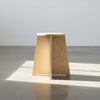
 The UNFNSHED Modern Desk in raw birch plywood. The grain runs the length of the work surface. No veneer, no paper foil, no edge tape.
How to read a desk spec sheet when it hides the material
Furniture brands use a range of terms to describe composite materials without calling them particle board. Here is what the language usually means:
"If the spec sheet says 'engineered wood' without specifying which type, it is usually particle board or MDF. Brands that use plywood say plywood."
Why the desk surface matters more than the legs
In desk construction, buyers tend to focus on the legs and frame because that is what holds the desk up. The work surface is where all the structural stress of daily use actually concentrates. Keyboards, monitors, forearms, coffee cups, cables: everything sits on the surface and everything exerts force on the surface.
A plywood desk surface distributes point loads across the cross-laminated layers. A particle board surface concentrates point loads at the face layer, which is why particle board desks develop surface compression marks over time from monitor stands, desk pads, and anything else that applies consistent pressure.
 A clean plywood surface stays clean. No depressions from monitor bases or consistent keyboard placement over time.
The zero-tool advantage: why the joinery matters for a desk
Most desks use cam locks, bolts, and dowels for assembly. These fasteners work, but they have a limited number of reassembly cycles before the cam lock holes strip or the dowel holes enlarge. Every time you move apartments or rearrange a room and disassemble the desk, you use one cycle.
A desk built on tension-fit joinery, where plywood panels interlock without hardware, does not degrade through reassembly because there is no fastener to strip. The wood-to-wood contact holds by tension and the geometry of the joint. You can disassemble and reassemble the same desk dozens of times without any loss of structural integrity.
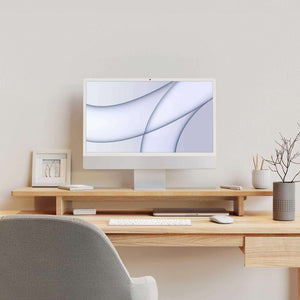
The UNFNSHED Modern Desk uses zero tools and zero hardware. The 13-ply premium plywood panels fit together by hand in under 15 minutes. The surface is 45 inches wide, which accommodates a 27-inch monitor with space for a keyboard and notebook. It ships flat and you can break it down the same way when you move.
 The desk works in a student apartment, a home office, or a first apartment. The footprint and surface area are sized for real work, not for a product photo.
Finishing a plywood desk: raw, oiled, or painted
Raw (no finish)
Raw birch plywood has a natural warm tone that is lighter than oak and warmer than maple. It is comfortable to rest your arms on and has a slight texture that prevents things from sliding. Raw plywood will absorb oil from hands over time and develop a natural patina. If you spill coffee, clean it immediately; unfinished plywood will absorb liquids.
Hard wax oil or tung oil
One coat of hard wax oil (Rubio Monocoat, Osmo, or similar) or pure tung oil gives the surface water resistance without changing the color significantly. This is the most common finish for people who want a natural look with functional protection. Apply with a rag, wipe off the excess, let it cure for 24 hours.
Paint
Plywood takes paint well, particularly on the face grain. The edge grain absorbs more paint and may need a sealer coat first. Chalk paint requires no primer. Any furniture-grade paint works with light sanding between coats. A painted plywood desk is indistinguishable from a painted MDF desk on the surface, but the structural difference underneath remains.

The edge of premium plywood shows every layer. That cross-laminated structure is what gives the desk surface its resistance to warping and point-load damage.
If you are comparing dimensions or deciding between desk sizes, the UNFNSHED Modern Desk page has the full measurements and photos from multiple angles. For a home office setup, the home office furniture collection shows how the desk pairs with the monitor stand and other workspace pieces.
Plywood desk questions
Is a plywood desk worth the extra cost over particle board?
For a desk you plan to own for more than three years, yes. Plywood holds screws reliably, resists warping in variable humidity, and can be refinished if the surface wears. Particle board desks often develop surface wear, screw stripping, or edge delamination within that timeframe, particularly in home office conditions where the desk is used daily.
How thick should a plywood desk top be?
A plywood desktop should be at least 18mm (about 0.75 inches) for a desk under 48 inches wide. For wider desks, 24mm or thicker prevents noticeable sag over the span. A 13-ply sheet of premium plywood at 18mm is rigid enough for the standard home desk width of 40 to 50 inches without support legs in the middle.
Can I stain a plywood desk?
Yes. Baltic birch plywood takes stain on the face grain, though the edge grain absorbs stain differently and usually goes darker. This is a natural characteristic of plywood edge grain. If you want uniform color across face and edge, use a paint or a tinted oil rather than a traditional stain.
What is the difference between Baltic birch and regular plywood for a desk?
Baltic birch has more plies per inch of thickness, tighter grain, and minimal voids in the inner layers. Construction-grade plywood may have gaps in the inner veneers that compromise edge-grain appearance and screw-holding strength at the edges. For furniture, Baltic birch is the standard because the edge looks finished rather than rough.
How do I protect a plywood desk from scratches?
A thin coat of hard wax oil (Rubio Monocoat, Osmo Polyx) is the simplest protective finish that maintains the natural wood look. A desk pad under your keyboard and mouse area handles the remaining wear. If the surface does get scratched, light sanding with 180-grit paper followed by re-oiling repairs most surface scratches on a plywood desk, which is not possible on a particle board or MDF surface.